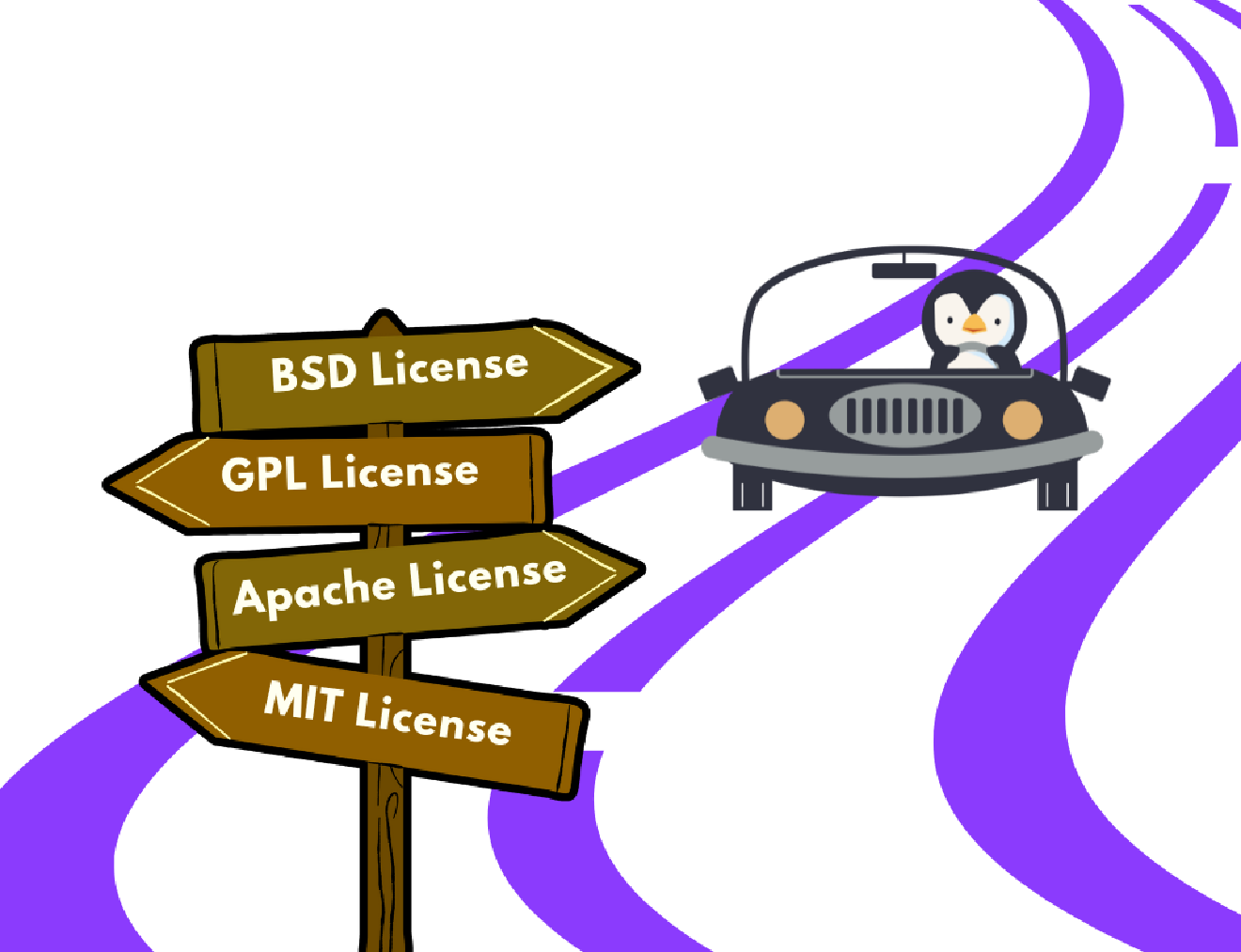
What is Open-Source Licensing
Open-source licenses are software licenses that allow content to be used, modified, and shared. Their main goal is to facilitate free and open-source software (FOSS) development.
Different Classes of Licenses
Open-source licenses are categorized as either copyleft or permissive.
- Copyleft licenses: A method for making a software program free while requiring that all modified and extended versions also be free, released under the same terms and conditions.
- Permissive licenses: Allow anyone to use, modify, and distribute the software without any restrictions or obligations. The software and its derivatives can be incorporated into proprietary or closed-source products without having to disclose the source code or share the modifications.
Distinguishing Between Different Licenses
BSD License
In the late 1980s, the University of California, Berkeley created an Operating System based on the original UNIX — thus came the Berkeley Software Distribution (BSD) permissive license. The BSD License allows proprietary use and allows the software released under the license to be incorporated into proprietary products.
MIT License
The MIT License is a permissive software license similar to BSD, tracing its origins back to the Massachusetts Institute of Technology (MIT) in the late 1980s. It’s the most widely used open-source license and is considered the least restrictive one out there because of its simplicity and flexibility.
Apache License
The Apache License is a permissive free software license written by the Apache Software Foundation (ASF) in early 2004. It allows users to use the software for any purpose, to distribute it, to modify it, and to distribute modified versions under the terms of the license, without concern for royalties.
GPL License
The GNU General Public License (GNU GPL or simply GPL) is the first copyleft license. It was first written by Richard Stallman in 1989, the founder of the Free Software Foundation (FSF), for the GNU Project.